
Class A vs Class B Couplers under BS EN 74-1:2022+A1:2025: What the Class Means and How to Prove It
What Class A and Class B mean for each coupler type in BS EN 74-1:2022+A1:2025, who sets the class, and which documents support it beyond a stamped mark.
Published · By Ethan, ScaffoldCoupler.com
An order that says “EN 74 Class B” is asking for something specific, and a supplier can answer it with a stamped letter or with documents. A stamped letter on its own does not prove the class. This guide sets out what Class A and Class B mean for each coupler type in the current edition, BS EN 74-1:2022+A1:2025, who decides which class a job needs, and what to ask for before you accept, or offer, a class.
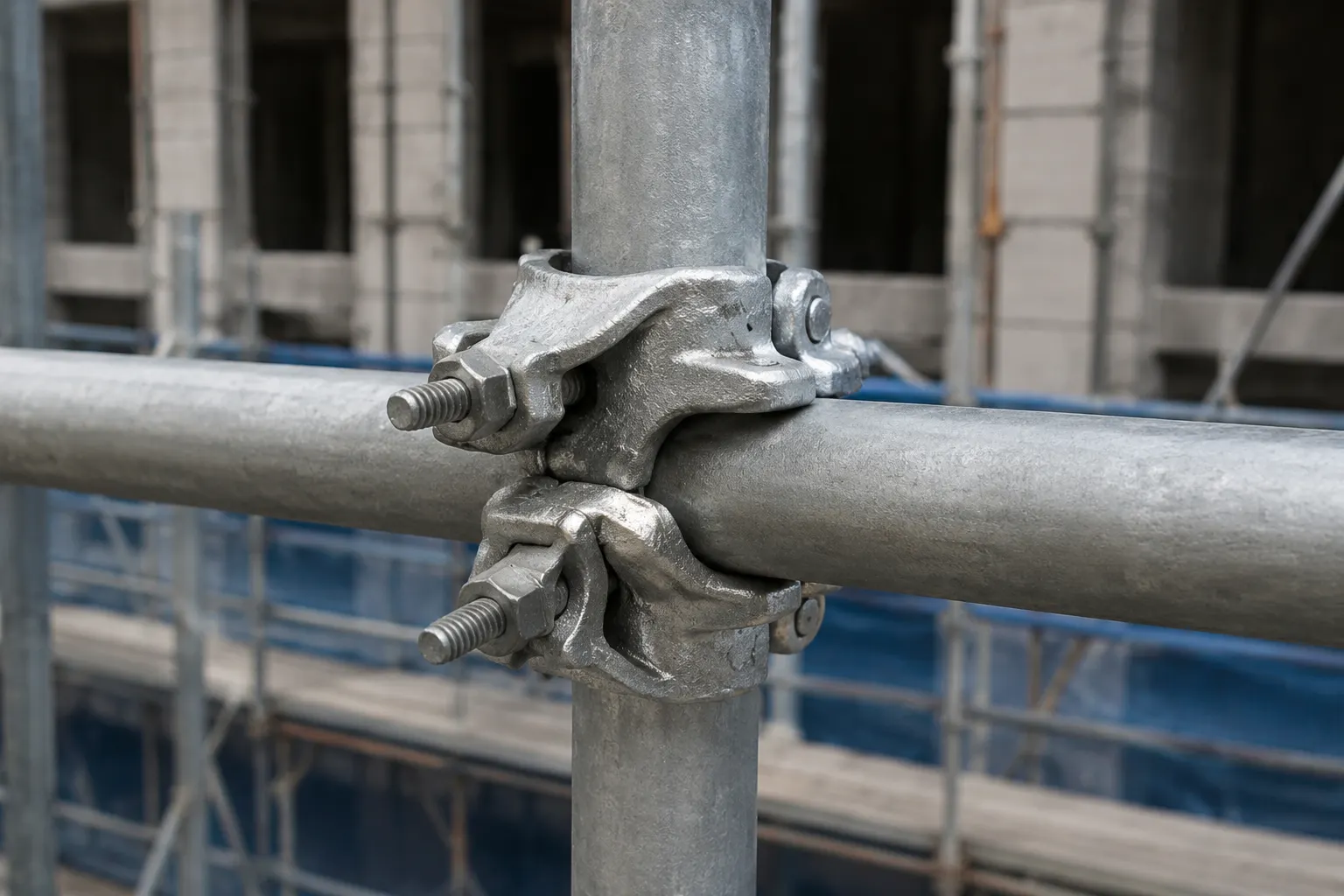
What the class means, type by type
Clause 4.2.1 says that Classes A and B differ in the internal forces and moments the coupler can transmit and in their load-bearing and stiffness values. Table 8 gives the numbers. These are the headline rows for each of the four coupler types that BS EN 74-1:2022+A1:2025 covers:
| Coupler type (BS EN 74-1:2022+A1:2025) | Classes | Slipping force Fs,c at 1–2 mm, Class A / Class B | Failure force Ff,c, Class A / Class B | What else differs between A and B |
|---|---|---|---|---|
| Right-angle (RA), the double coupler | A, AA, B, BB | 10,0 / 15,0 kN | 20,0 / 30,0 kN (AA 30,0 kN, BB 45,0 kN) | Pull-apart force 20,0 / 30,0 kN. Class B and BB alone carry the rotational-moment, rotational-stiffness and cruciform-bending requirements, and those apply to screw couplers only |
| Swivel (SW) | A, B | 10,0 / 15,0 kN | 14,0 / 20,0 kN | Higher values only; no pull-apart, rotation or bending requirement in either class |
| Parallel (PA) | A, B | 10,0 / 15,0 kN | 20,0 / 30,0 kN | Higher values only |
| Sleeve, friction (SF) | A, B | 6,0 / 9,0 kN | Not a Table 8 row for this type | A bending moment MB,c of 1,4 kNm, Class B only |
Transcribed from Table 8 of BS EN 74-1:2022+A1:2025. For right-angle, swivel and parallel couplers, Table 8 also has a slipping row at Δ1 ≤ 7 mm and an indentation test; the full right-angle and swivel tables are in the double coupler and swivel coupler guides. The sleeve coupler has only the two rows shown here, slipping at 1–2 mm and the Class B bending moment; the sleeve coupler vs joint pin guide covers it. There is no separate parallel-coupler guide, so its headline values are the ones in this table.
Three points stand out from the table:
- “Class B” is not one strength. In this edition a Class B swivel coupler has a failure-force requirement of 20,0 kN; a Class B right-angle coupler has 30,0 kN. A class letter means something only next to a coupler type and an edition.
- For a right-angle coupler, Class B adds requirements, not only bigger numbers. The rotational and cruciform-bending requirements exist only in Classes B and BB, and Table 8 marks them as applying to screw couplers only. A test report for a Class B screw-type double coupler therefore has to cover tests that a Class A report does not.
- AA and BB are right-angle classes only. The doubled letters allow two identical couplers to be positioned touching each other to increase slipping capacity, and Table 8 also sets a higher single-coupler failure force for them (AA 30,0 kN, BB 45,0 kN). The double coupler guide explains the pairing rule.
Who decides the class
Clause 6.2.1 of BS EN 74-1:2022+A1:2025 sends the reader to EN 12811-1 and EN 12812 for the values and safety coefficients to apply in use, which is design work. That is why we treat the class as a design and specification input: confirm it with the buyer and the person responsible for the scaffold design, and do not let a supplier change it on its own. Our job as a sourcing partner is to find couplers that meet the class on the order and to show the evidence for it.
Two consequences follow:
- Class letters are per type. One order can call for Class B double couplers and Class A swivels. Each coupler type needs its own line and its own class, written as a clause 8 designation such as
EN 74-1 RA B C2 Mfor the doubles andEN 74-1 SW A C2 Mfor the swivels. - Countries differ on assessment. The note to clause 12 says requirements for assessment vary between countries. If the coupler will be used in a country you have not supplied before, ask the buyer which assessment and which documents they accept before you quote.
What supports a class claim: assessment, manual and a matching mark
Clause 9 of BS EN 74-1:2022+A1:2025 requires every coupler to carry a mark that includes its class, impressed or embossed on the flap or body and legible after coating. The manufacturer applies that mark. Clause 12 requires the assessment to be carried out by a person or organisation different from the coupler’s designer, and clause 13 requires the product manual to name the assessor and include a copy of the assessment statement. So the evidence chain runs in this order:
- The type-test assessment for this coupler type and this class, against a named edition.
- The product manual, which names the assessor and carries the assessment statement.
- The mark on the coupler, which has to match both.
A mark without the first two links is a claim, not evidence.
What to check in a Class B report. Make sure it covers the class you are buying, not only the coupler type. For a screw-type right-angle coupler under the current edition, Table 8 sets Class B requirements for slipping, failure, pull-apart and indentation (a test load Pind of 10,0 kN with Δ10 ≤ 1,5 mm), plus the Class B-only rotational and cruciform-bending requirements. A report that covers only slipping and failure does not support a Class B claim for that coupler. These are type-test requirements, not working loads. Check the edition too: a report written to EN 74-1:2022 before amendment A1:2025 predates the amended slipping evaluation rule (what a type test involves).
Why we insist on this order. During our own supplier checks in October 2026, a factory told us it stamps markings to whatever the customer asks for, while the type-test reports it holds covered Class A only. That is why we treat a class letter on a part as something to check against a report, never as proof.
If your supplier only has Class A
When the order says Class B and the factory’s evidence stops at Class A, there are three honest routes, and one that is not.
| Route | What it involves | What it depends on |
|---|---|---|
| Offer Class A, clearly labelled | Quote the couplers as Class A, attach the Class A report, and say so in the quotation | In our practice, written acceptance from the buyer and from the person responsible for the scaffold design |
| Commission a Class B assessment | The factory has the coupler type-tested against Class B, with the assessment carried out by a party other than the coupler’s designer (clause 12) | Whether the coupler passes, plus the time and cost of testing, which we cannot state in advance |
| Source from a factory that holds Class B evidence | Look for a factory whose report covers the same type, Class B and a named edition | Checking that the report matches the coupler actually supplied |
| Not a route: stamp “Class B” on Class A couplers | A mark the evidence does not support | Nothing. It misdescribes the goods and leaves the risk with whoever sold them |
A test result above the Class B values in a Class A report does not turn the coupler into Class B. If the Class B-only requirements were not tested, the coupler has not been assessed as Class B.
What to ask the supplier for
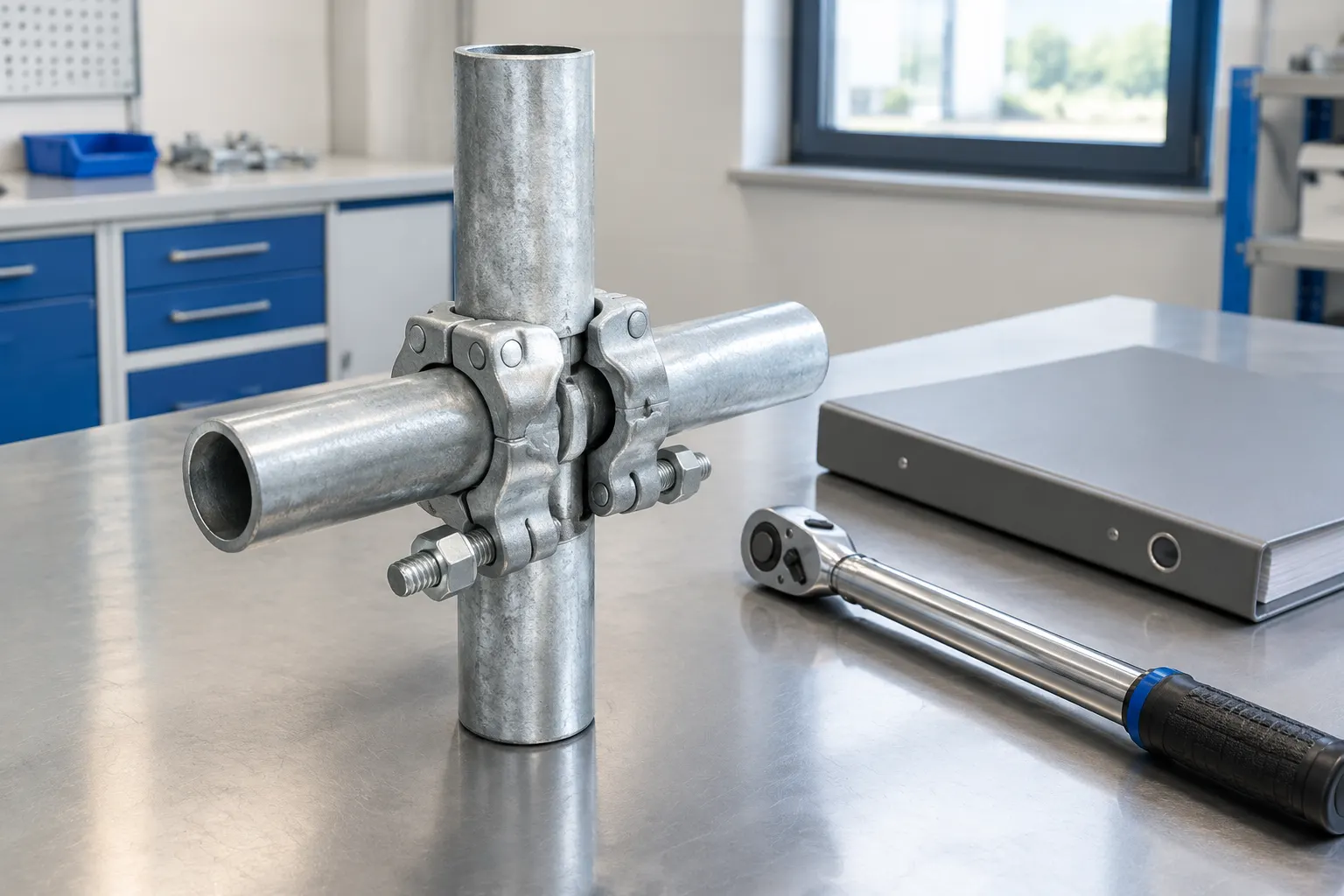
Ask for these before a first order, and check them against each other:
- The type-test report for the exact type and class on your order, showing the report number, the type and class tested, the edition it was written to, the date and the tightening condition (50 Nm torque wrench for screw couplers under BS EN 74-1:2022+A1:2025). A report for a different coupler type, or for Class A when you ordered B, does not count.
- The report as the laboratory issued it. A translation made by the supplier, or by us, is not the report. If the copy you receive says it is a translation, ask for the original and verify it with the issuing laboratory.
- The product manual, which under clause 13 names the assessor and carries the assessment statement.
- The production-inspection letter. The clause 8 designation has an inspection field that can read L, M or X. Annex B, which is informative, describes L as the manufacturer’s own control and M as control supervised by an independent certification system. If you want M, write it into the designation and ask for the latest third-party inspection report. If a supplier quotes X, ask it, or the assessor, what X stands for and on what basis; we have not recorded a definition for it.
- A marking check on a sample, after galvanising, to confirm the class letter matches the line on the order and the report.
For the rest of the order lines (finish, construction, quantity and tube), see the purchase-order list in the coupler types guide and the order checklist in the BS 1139 vs EN 74 guide.
Send a coupler specification with the type, class and edition for each coupler, and tell us which documents your project needs. We will tell you which of them a factory can actually show.
Frequently asked questions
▸What is the difference between Class A and Class B scaffold couplers?
In BS EN 74-1:2022+A1:2025 the class sets which type-test requirements a coupler prototype has to meet, and the meaning depends on the coupler type. For a right-angle (double) coupler, Table 8 requires a characteristic slipping force at 1–2 mm displacement of 10,0 kN for Class A and 15,0 kN for Class B, a failure force of 20,0 kN against 30,0 kN, and, for Class B screw couplers only, rotational and cruciform-bending requirements that Class A does not carry. For a sleeve coupler, the Class B-only requirement is a bending moment of 1,4 kNm. These are type-test values, not working loads.
▸Is a Class B coupler stronger than a Class A coupler?
Only within one coupler type and one edition. In BS EN 74-1:2022+A1:2025, a Class B swivel coupler has a failure-force requirement of 20,0 kN, while a Class B right-angle coupler has 30,0 kN, so 'Class B' does not name a single strength across types. The values are characteristic type-test requirements for a prototype; the load a coupler may carry in a scaffold comes from the scaffold design.
▸Can I supply Class A couplers when the order says Class B?
Not as a quiet substitution. We treat the class on an order as a design and specification input that the supplier should not change on its own. If only Class A is available, put that to the buyer in writing, state that the couplers are Class A, and in our practice proceed only once the buyer, and the person responsible for the scaffold design, have accepted Class A in writing.
▸Does an 'EN 74-1 Class B' mark on a coupler prove its class?
No. Clause 9 of BS EN 74-1:2022+A1:2025 requires the class letter to be impressed or embossed on the coupler, but the mark is applied by the manufacturer. What supports the class is the assessment for that coupler type and class, which clause 12 requires to be carried out by a person or organisation other than the coupler's designer, together with the product manual, which under clause 13 names the assessor and carries a copy of the assessment statement.
Sources
Related guides
-
BS 1139 vs EN 74: How the Scaffold Coupler Standards Relate and What to Specify
How BS 1139 and EN 74 relate, from BS 1139-2.1:1991 to BS EN 74-1:2022+A1:2025, what changed in the coupler tables, and what to write on an order.
- Guide hub
Scaffolding Coupler Types and Names: Chart of UK and US Names, Uses and EN 74 Classes
Scaffolding coupler types by name: double, swivel, parallel, sleeve, joint pin, putlog and beam clamp, with UK and US names, uses and EN 74-1 classes.
-
Scaffold Beam Clamp (Girder Coupler): What EN 74-1 Covers and What to Ask
What a scaffold beam clamp or girder coupler is, why BS EN 74-1:2022+A1:2025 has no load table for it, and what to ask a supplier before ordering.
-
Sleeve Coupler vs Joint Pin (Spigot): Which Standard Covers Which
How a sleeve coupler and a joint pin differ, what BS EN 74-1:2022+A1:2025 requires of the sleeve coupler, and which document covers the spigot pin.